
The scribblings of a widower in his sixties who has discovered the therapy of the written word. Join me on my journey from grief to satisfaction and how I eventually got there.

About me
I am a sixty-five-year-old widower, (In 2023). I discovered writing to cope with the grief of losing my wife of thirty-five years to cancer. I began by writing my first short story, The Slow Cooker (Link to the story here).https://scatterbrianblogs.com/the-slow-cooker/
This was followed by a story about each of the five stages of grief. Here I am, over one hundred and fifty stories later and four novels in progress.
Follow me on my journey, whether you’re a fellow sufferer or just keen on a story.
READ MY NOVELLA; THE PAINTING, FREE!
Read how a young Scotsman falls in love with a woman in his dreams, to discover that she exists when he meets an old Egyptian painter. Read about how their meeting saves the world from nuclear war.
Today’s Story
Red Shoes: Part Three
The following morning, I recalled both dreams, but without the trepidation that the former usually brought. It was Monday, here in France, worse than Sunday. For some reason, more establishments close than on the Sabbath. This included the boulangerie, another day without my favourite breakfast. What’s more the baguette on the windowsill was another day older and resembled a weapon more than an item of foodstuff.
***
What you don’t realise is that all of this is a distraction. This is your life from now on. Stop dwelling on the past and embrace the challenge of making breakfast with an ancient French stick.
***
I livened the fossilised loaf up by sprinkling it with water and placing it in the air fryer. Two minutes later it was almost edible.
I looked around but there was nobody there, save Bobby the Russian Blue who was my constant breakfast companion. I had previously treated him with disdain, which had somehow endeared Bobby to me. He was someone to talk to first thing, when my anxiety was at its greatest. He never answered back and was not judgemental. Was Bobby a distraction too?
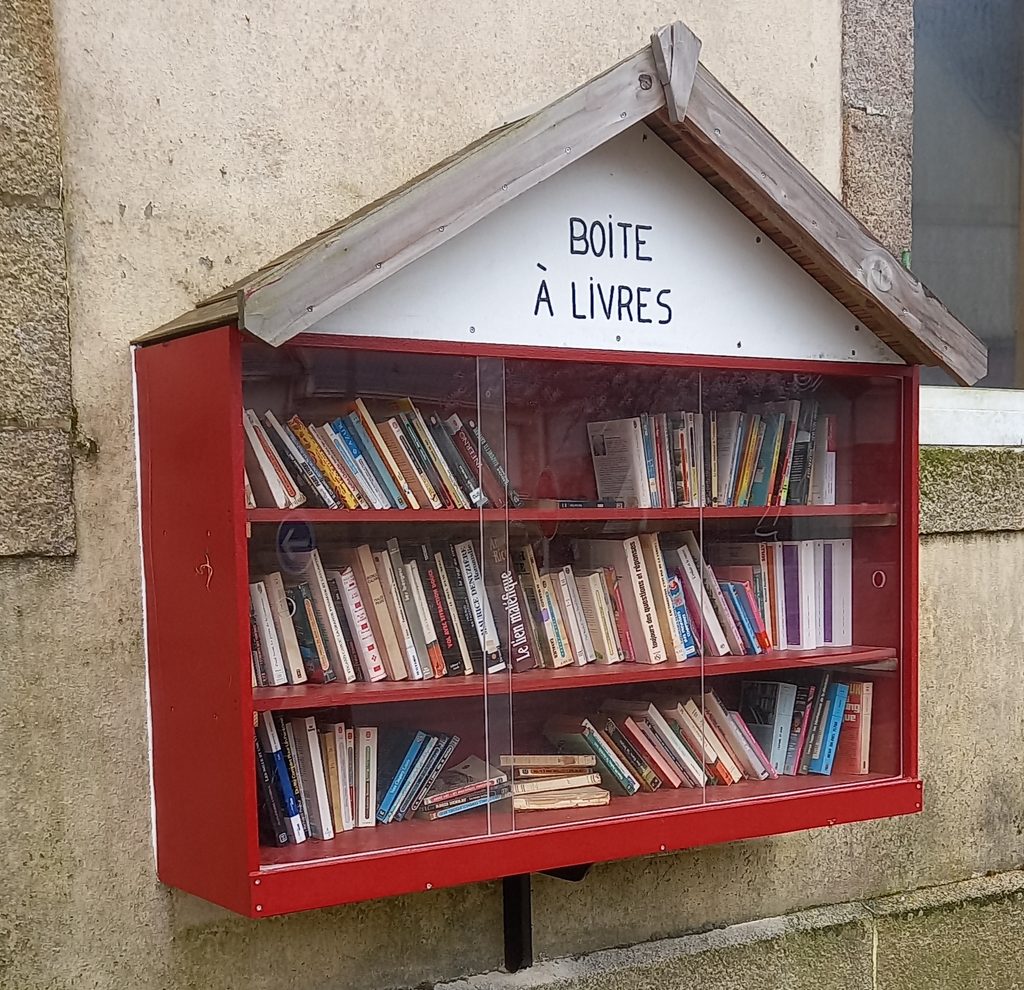
I washed up and got ready for my first walk of the day. The sun was shining and generously giving out its spring heat, even at ten in the morning. I pictured the enigma worshipping its rays. Anti-clockwise was my chosen direction this morning, due to the closed bakery and I wanted to check out the Boite à Livres, or Box of Books. This consisted of a tiny glass fronted cabinet filled with tomes donated by locals and tourists alike. If you were lucky you would find a discarded English holiday read. Once I discovered an old copy of The Old Man and the Sea, by Ernest Hemingway. On one side it was in English and the other in French, quite a find!
As usual, I passed the time of day, briefly but attentively, with a selection of residents, gradually building my fragile self esteem. I began to realise that human interaction, even at the briefest level, was valuable when it was so positive. How inexpensive it is to greet a fellow human with a word or two of felicitation. It was so different back home where most fellow walkers were accompanied by a canine companion. It was obvious that they preferred the company of their dog to that of a total stranger.
I once carried out a series of experiments while walking along the promenade of my home town; promenade as in coastal walkway as opposed to the French meaning. If someone approached with a dog, either on or off its lead, I would ignore it and look away. The subsequent owner of the beast would deliberately ignore me, even if I tried to make eye contact. The following day, I would change my stance and greet the animal with a broad smile, while silently mouthing hello. In almost every case the following human companion would offer me the most cordial of greetings. Even those who had ignored me the previous day. Quite a distraction, I pondered as I approached the white radish field. The large, gnarled white root vegetables were almost at maturity, with a fine display of leaves above. I had recently discovered that these plants were ploughed back into the soil on reaching maturity, to fertilise the land for a subsequent crop, usually maize. Very unusual, and distracting.
As I approached the line of trees separating the field from the sports pitches, my stomach tightened in anticipation. The grassed area opened up before me and I noticed the little black ball curled up on my favourite bench. The red shoes were visible beneath the bundle and the white disc of her face was illuminated by the sun. My heart gave a jump as adrenaline flooded my mouth and bloodstream. I would greet her. After all, we had spoken before, in my dream.
I neared the mobile phone mast, conscious of the buzzing of the equipment in the small compound behind her. She didn’t move. I cleared my throat as the path came level with the bench – nothing. My mouth opened to instigate the greeting but the word froze in my throat. The momentum of my stride carried me past my enigma and my heart sank with both disappointment and adrenaline withdrawal. By the time I had reached the other corner of the field, I was cursing my inadequacy.
Suddenly, I turned on my heels and headed back to the mast. No fight or flight drug, just a determination to make contact. I strolled up to the bench and uttered a clear, “bonjour.”
“So, you have found your tongue at last. Please, take a seat. After all, it is your favourite spot is it not?” The woman replied without moving. As the sun illuminated her features, I absorbed her countenance. Her skin was pale, almost translucent and seemed to be immune to the rays of the sun. Even at this time of year and mid morning the UV could be destructive as I had discovered on a four hour walk into Morlaix. My face had burned for days after, the skin peeling on my nose, despite the use of factor thirty.
There seemed to be no trace of sunblock on her skin, which was flawless. It reminded me of a Japanese Manga character, as did her economic features; all except her eyes. Although closed, her eyelids were long and curved, hiding those large black orbs of my dream.
“Do you live nearby? Are you a dancer?” My questions seemed stilted, scant. I looked down at her feet. They were tiny, like those of a child, clad in red silk; spotless, despite the recent rain.
“Live?” She laughed, like the breeze through a delicate glass wind chime.
Like what you see? Check out more!
Read my other stories from past days.