
Chapter One
January 15th, in the year of our Lord, 1998. Ploubazlanec, Brittany.
The battered 2CV Fourgonnette bounced into the village square in Ploubazlanec. The two-cylinder Boxer engine coughed, then died.
“Will this do, young man?” The driver shouted, failing to adjust to the silence.
“Thank you. This is perfect. I am grateful for your kindness,” the tourist replied in his best French.
“Not at all, Yaw. I hope you find what you’re looking for.” The old man’s voice had compensated for the unconscious Citroen. “Don’t forget, you are welcome in my home anytime. It’s only a twenty-minute walk from here. Ask anyone in the village, they all know me,” he continued. His swarthy, pockmarked face, which resembled the nearby sea-battered rocks, showed genuine sincerity. His eyes, mindful of two shining mussels clinging to the rock, displayed intelligence.
“I will be sure to take you up on your kind offer,” the passenger responded. “By the way, it’s João, you can call me Jean, it’s the same.”
“I’ll try and remember. Alain Paillote. It is a pleasure to make your acquaintance,” the man replied. João stepped out of the van, causing it to rock gently on its tired springs. Had he not been a hardened sailor, he pondered, he would have surely been stricken by seasickness. The combination of the ancient van’s suspension, the bomb cratered roads and the constant smell of petrol was a nauseating concoction. He’d spent more comfortable times on a choppy day in the Bay of Biscay.
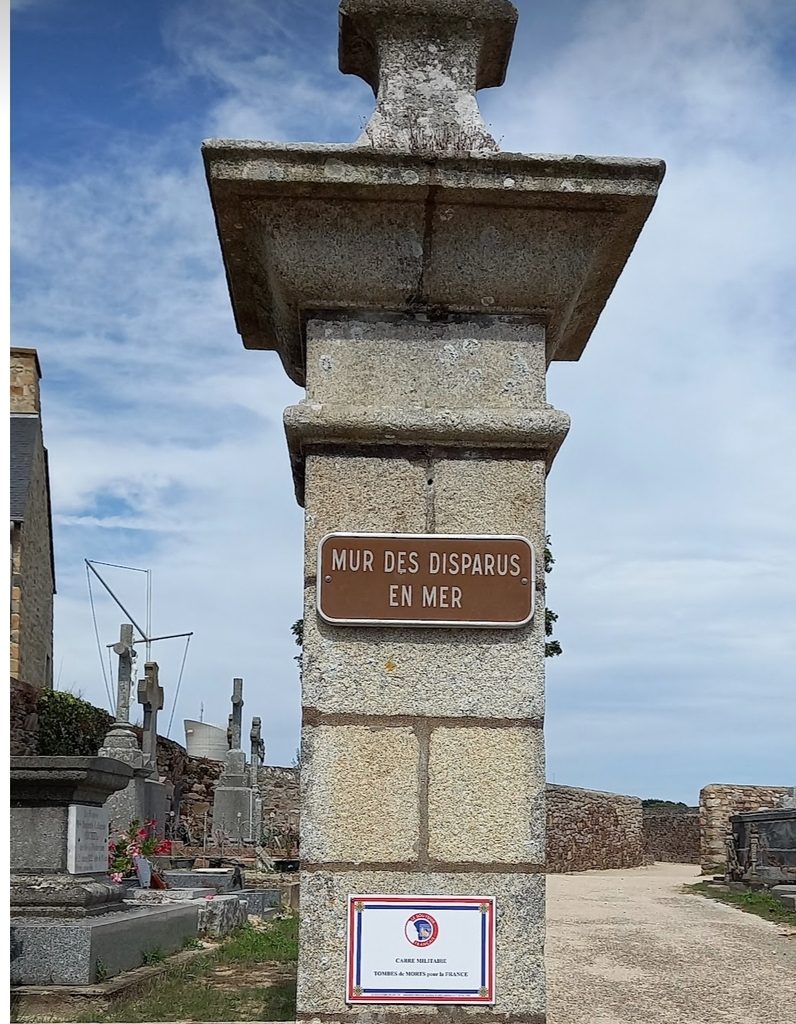
João managed to close the paper-thin door at the third attempt, fearing it would fall off its hinges, and waved goodbye to his benefactor. The driver breathed life into the old vehicle, and the resulting cloud of black smoke dissipated, revealing two stone pillars. João recognised them from his research, as the two columns which guarded the Cimetière De Ploubazlanec.
The upright on the left bore a sign in brown and cream, of the kind directed at tourists.
MUR DES DISPARUS EN MER
Wall of the Missing at Sea, João translated into his native Portuguese. His chest tightened at the words on the sign as he prepared to enter the graveyard. Despite the single-figure temperature, he began to sweat in several places. The cold liquid on his skin did its work, and he shivered. João had no time to prepare himself as he was hit by the first plaque.
Fixed to the stone wall by rusting brackets, the marble tribute had cracked in four. One quarter, the lower left, had parted from its fellow pieces and hung precariously. All he could make out from the faded inscription was a year, a Christian name, and one word which would become a common theme.
1922
Le Françoise
Guillaume
Regrets
The young man’s feelings were mixed at the sight of the mournful memorial. Regret, as it concluded, for those lost and those left behind, and a sense of relief that it wasn’t what he was searching for. Taking in a lungful of the damp, chilling air, João worked his way along the linear tributes to those claimed by the waves. He felt like a visitor to a macabre gallery of morbid paintings. Each one, a story of anguish in the name of survival.
João kept a mental tally of the ‘disappeared’ on each plaque until he lost count around fifty. Then, all at once, it was there in front of him. The sensation was sub-zero, Arctic, reflecting the words on the stone. ISLAND, ICELAND. Words which looked like they had just been carved by the engraver, on a slab freshly cut by the mason.
The names, the date, the vessel; all so familiar to him, even though he was seeing it for the first time.
1912
LEOPOLDINE
Joseph, Bernard, Antoine
…et son fils Jean,
dix-sept ans.
Regrets.
His search was over. Or rather, had just begun.
Chapter Two
January 15th, in the year of our Lord, 1912. Ploubazlanec, Brittany.
“It’s time.” The voice cut through the thickness of his dream. A warm knife through butter. He felt both sensations. Sharp metal, soft butter.
“Papa?” He called.
“Yes, Jean.” The reply.
“Is it really time?” His stomach muscles cramped.
“Let’s go. They’re waiting.” Confirmation. Years of waiting were over. From the day he had been able to think for himself, Jean was destined to go to sea. He was drawn onto the waves by his ancestors.
The room was dark and damp, but his bed was warm and dry. He would leave one for the other. It had to be so. Jean threw off the blankets and his childhood, shivering as he did so.
“I’m ready, Papa.” He was wearing the clothes his community had given him. The thick woollen jumper, the oilskin pants and the boots of leather, replacing his wooden sabots. Not second-hand but inherited, like the family jewels passed down the generations. He sat at the table opposite his father, an equal now with his own bowl for coffee and his own knife to cut bread and gut fish.
“Where shall we go, Papa?” the boy asked, even though he knew the answer. He wanted to hear it from his father’s mouth, the one he trusted more than life itself. The word picked him up and gripped him in a frozen embrace, sending shivers down his spine.
“Iceland.”
There it was. Confirmation of his coming of age. An icy maturity enveloped him like a chilling mist. He hugged his mother and his three sisters, Anna, Melanie, and the youngest, Elodie. The latter squeezed the breath out of him, refusing to let him go.
“You will come back, won’t you, Jean? Promise me,” the child pleaded.
“I promise,” he answered simply, kissing her on the top of the head.
“Take this,” she said, turning to her mother, who nodded with approval. She handed her big brother a leather thong bearing a silver coin. As he took the gift, she placed her hand over her chest and closed her eyes as if to pray.
“Thank you, Ellie, I shall treasure it and bring it home to you.” He slipped the pendant over his head, then followed his father out of the cottage.
It was a short walk to the harbour; he’d done it so many times, in both directions. This time, though, there was no return journey. No empty feeling in his gut as he watched the Leopoldine disappear over the horizon. No pang of pain at missing his father. He was here, by his side, and he would be with him as it was the village’s turn to dip below the sea.
They were all there to greet him on the quay, his two uncles, Antoine and Bernard and his four cousins, whom he’d barely seen since they had turned seventeen. The men scooped him up and carried him aboard the Leopoldine.
“Cast off, Antoine,” called his father and Jean’s stomach cramped again. A giant Gannet had found its way inside him and was struggling to get out. He felt a hand on his shoulder. Looking up, he saw not his father, the kind, generous man whose hugs were priceless, but the skipper’s stony face, all emotion banished, his eyes as black as the pitch between the decking.
“You know what to do, man. You’ve practised many times. Now do it!” He bellowed. Did he say man? He set about his task with a newfound confidence. No Gannet, no cramps, he was a man now, in a man’s world.
Jean pulled on the thick rope, the fibres digging into his palms. He knew he’d suffer at first, despite all of his preparation. The skin would blister; pain unbearable, but worth it. Soon his hands, like his father’s, would be as hard as leather.
Jean thought about his mother and three sisters as the church spire dipped below the horizon. He placed his hand on his chest and felt the amulet beneath his shirt. A sudden feeling of exposure hit him, as if he were suspended in midair. The ocean surrounded him, and the vessel, once a giant structure, towering over the harbour, became a leaf in a pond.
There was a loud crack as the wind changed direction, filling the mainsail. Jean was thrown across the deck, banging his head on the hull. Two giant hands picked him up, and he was staring in the face of his uncle Bernard. Two icy blue eyes shone through the tangle of whiskers holding him in their grip.
“Not got your sea legs yet, young Jean.” The giant carried him back to his post and put him down gently. “Go with the ship, be part of her. She’s your world now.” The smile from the big man was exactly what he needed. A smile he’d one day forget.
Chapter Three
January 15th, in the year of our Lord, 1998. Ploubazlanec, Brittany.
João took the phone from his coat pocket and put his bag down. He held up the handset and took a photograph of the stone. Checking to make sure it was clear, he then opened WhatsApp. The image was tragically perfect, just as he’d first witnessed it minutes earlier.
He selected ‘Papa João’. The avatar smiled back at him. It was like looking in the mirror of the future.
Send.
Two grey ticks. Gone.
Two blue ticks. Received.
Four crying emojis. Replied.
His father had just managed to master the social media app when his son set off on the journey. Nothing else would have tempted him to do so. Now he was sending emojis! He smiled and typed.
“I found him, Papa. He’s here. They both are.”
Four more emojis.
“Thank you, my son. Now, continue your journey.”
João stared at the screen momentarily. He knew an answer wasn’t necessary, so he placed the phone in his pocket. He looked around the way a thief would before stealing something. His hand reached out and touched the plaque.
As he made contact with the cold, damp marble, a chill spread through him. He was transported to another time and place. He felt the freezing waves pulling him down, the numbness paralysing his muscles. He tasted the salt as the water inundated his mouth and lungs. Death was swift, merciful. The sea, so often blamed for its cruelty, was kind in the end.
“Can I help you?” João gasped at the sound of a voice, alien to the world he’d just visited. He took a deep breath of the sweet, moist air.
“I’m fine. I just feel a bit sick,” he responded, turning to the source of the sound.
“Yes. You look a bit unsteady. Have you come far? Have you eaten?” The young woman came into focus. Was he still at sea? Was she a mermaid? The image before him was straight from a fairy tale. He had drowned, and heaven was beckoning in her eyes. He lost the feeling in his legs and staggered forward, collapsing onto the verge in front of the plaque.
*
João opened his eyes. A brass chandelier hung from the centre of a ceiling rose. He stared at it, studying the detail on the pendant. There were five candle bulbs with bases that resembled the real thing.
“You gave us a shock there,” the voice said again. He was in Heaven. “Here, sit up. Maman has made some soup,” the angel said. He took in the rest of the room. It was overwhelming. Paradise was several decades of French décor all in one room.
“What happened? Where am I?” João stammered. He tried to get up, but every bone and joint screamed for him to remain still.
“It’s OK, you’re safe. I don’t know what you’re saying, but if you can understand me, everything will be fine. My father carried you from the cemetery” The female voice spoke in French, but he understood. Why couldn’t she? Then it hit him. He’d been speaking in his native tongue! “He says he knows you. He brought you to our village in his van.”
“Please forgive me, mademoiselle, I think I banged my head when I fell.” He reverted to French. “Your father is Monsieur Paillote?”
“Oh, you did. You have quite an egg there,” the siren replied. He turned towards her, his neck protesting, and was again enchanted by her natural allure. “Yes, he said he picked you up in Morlaix. I’m Marie, by the way,” she continued. Her hair was the colour of a fox’s pelt and her skin like fresh milk. Freckles spread from the bridge of her small nose like copper coins spilling from a bride’s dowry. Her emerald eyes and pale pink lips combined in a stunning smile.
“João, but please, call me Jean,” he answered.
“I know! Tell me. Why that plaque, Jean? Is it significant?” Marie enquired.
“No,” João replied curtly.
“I see,” the woman said. She didn’t seem convinced. “Like all of the memorials, it carries a tragic story. May I?” She lifted his head and placed a yellow satin cushion under it. Picking up the bowl, his angel proceeded to feed him the most delicious fish soup. If this were heaven, he was happy with it.
“Would you tell me the story?” João asked between helpings.
“I can do better than that. When you’re well enough, I’ll introduce you to someone who knows it personally,” Marie countered. João’s mouth fell open and his face froze.“Are you alright? You look like you’ve seen a ghost – again,” Marie said to the shadow that was João. The young man was unable to reply; instead, reverting to vague gestures. He nodded, then shook his head, neither of which answered the young woman’s question. “You’re not, are you? Since you collapsed at the wall, you’ve been a basket case.” Her voice faded, and darkness surrounded him again.
Chapter Four
January 17th, in the year of our Lord, 1912. Atlantic Ocean, off Ireland.
Blisters erupted on both of Jean’s hands, in every imaginable place. He counted six on one hand and one extra on the other, thirteen in total. They became his babies to nurture and care for.
Every pull on the rope stung like the tentacles of a Portuguese man o’ war, combined with an anxiety that, at any moment, one of them would burst.
“You must not allow them to rupture,” his father demanded. Despite their appearance and texture, the soft, liquid-filled afflictions would be his saviour.
However, these same deformations of the outer skin could become his enemy. Breaking the skin and allowing a liquid to escape would mean that the callus could not form, exposing the living skin beneath. The consequent risk of infection could see him idle for days or even weeks. The crew could not afford to be one man down. The balance between hard work and caring for his hands was a tightrope walk. Jean had seen men returning with missing fingers. One of his great uncles even lost his hand.
Infection was the evil twin of frostbite; the latter would not trouble the young fisherman for several days yet. When it eventually greeted him, he would never forget it. Jean had so many challenges in this inhumane environment. Where he was heading was not favourable to human existence, he pondered as he worked. Like the deep Ocean underneath his feet and a star-filled sky above his head, those were places where man was not welcome.
As he rubbed the special mixture on his puffy hands at night, he challenged his presence on the boat. Unlike his elders and peers, he didn’t follow the old ways without question, even though he had been desperate to go to sea. The land surrounding their village was fertile and bountiful; however, it was controlled by the landowner, and those who worked the fields barely scraped a living. Change had come in the form of three revolutions, but the Third Republic was no better than the monarchy had been.
Their journey was long, hard and dangerous, but the rewards of a safe round trip were huge. The cod, or Bacalhau, as the Portuguese called it, was dried and salted. The resulting product was consumed throughout Europe.
Jean’s mind turned to the Portuguese. His father had told him of their long seafaring history. They were expert sailors, and their kin had discovered half of the New World. Competition was tough in the Icelandic waters, and there was no love lost between the two sets of rivals.
Every day, the temperature dropped another degree. Soon, ice formed on the rigging in the shape of long white daggers that could cut a man’s head open if one of them fell. The chill was like nothing he’d experienced, seeming to come from deep within his core. Worse was to come, nevertheless, as the weather, which had, until then, been anonymous, suddenly introduced itself.
Chapter Five
January 19th, in the year of our Lord, 1912. Iceland Sea
Jean was wrapping his thumb in a clean rag where frostbite had nipped him. Suddenly, the boat tilted violently, throwing him across the cabin. Immediately, he made for the deck. Something profound was happening. As he poked his head through the hatch, he saw his cousin Pierre lifted by a giant swell and carried overboard. His horror at that momentary scene was surpassed by the screams of his uncle Bernard as he witnessed the death of his son.
The world they had entered was more cruel than any tyrant at home. There was no place for emotion as the older man began pulling on the ropes that held the mainsail.
“Here, man! Hold onto this. If we don’t get this sail down, she’ll capsize for sure.” His voice was harsh and rasping. Spray soaked his beard. Jean stood motionless, trying to work out if there were tears in that salty deluge.
“Jean! Snap out of it now! Or we’re going down.” A huge hand smacked the side of his face, which turned numb. He came around and grabbed the rope tightly. He felt the skin tear on his hands and the slippery liquid ooze from the broken blisters. Gripping the rope tighter, he ignored the searing pain which shot up both arms. Another massive wave hit the deck, and his uncle was no longer there.
The next few seconds stretched out as a gust of wind grabbed the exposed sail. The destructive force flipped the boat over like a crêpe on the griddle. Air was replaced by water. Freezing, salty water. Then numbness, then darkness. Darker than the blackest sky.
Chapter Six
January 19th, in the year of our Lord, 1998. Chez Paillote, Ploubazlanec, Brittany
“João, wake up. Everything is fine. You’re having a nightmare.” A soft voice, feminine, reassuring him like his sisters’ did. Sisters? He had no sisters!
“Papa. Is that you? Uncle Bernard?” His language and accent were pure Breton. No awkward stumbling over the vowels.
Then light. Blinding, searing light burning his retinas. He closed his eyes, and white hot became red hot as the sensation eased.
He opened his eyes to see his guardian angel again. Flaming hair, cream skin and freckles. Her expression was different, more complex, more serious.
“This is not right. Who are you, João, Jean or whatever your name is?” Maria cried, pulling her hands away as if he were on fire. For several moments, there was silence as they tried to take in what was happening. Marie was the first to speak.
“That’s not the answer. It’s a question. I think I deserve answers, not more mystery. I have taken you in and looked after you for four days. You’ve been unconscious most of the time. When you do surface, I get this. Some kind of act. Nobody speaks Breton like that anymore, let alone a foreigner!” Even in her angry state, she was beautiful.
“I’m sorry. This is just as puzzling to me as it is to you,” João replied, this time in French, rubbing his eyes. “I feel as if I’ve entered another world.”
“You’re not making sense. Why are you here? What is the significance of the plaque?” Marie demanded. Her patience was wearing thin.
“Wait, listen. You said there was someone. Someone who knows about the Leopoldine,” João said, trying to focus on Marie’s exquisite face.
“You can forget that! I’m a fit young woman, and you’ve scared the life out of me. Can you imagine what it would do to a ninety-three-year-old? She’s very frail.” Marie snapped.
João did the maths. Ninety-three? That’s how old she’d be. There was a living human connection to the tragedy. Had the young woman just made that connection?
“Please! I must see Elodie. I need answers,” João blurted out.
“How do you know her name?” It was Marie’s turn to surrender to the crazy world this young man had brought with him.
“She’s my sister.” The words, in Breton, came from João’s mouth, but they were not his.
Chapter Seven
January 20th, in the year of our Lord 1912. North Atlantic Ocean
The boy opened his eyes to a sea of faces. They all had the same swarthy appearance, large brown eyes, and jet-black hair. Although varying in age, their features were almost identical. One began to speak, slowly followed by another, then a third, until they were all talking at once. The words were meaningless to the boy.
His next sensation hit him hard as every part of his body seemed to be on fire. The flames were inside him, not on the surface; his veins were full of boiling liquid. He tried to scream, but all that came out of his mouth was a dry clicking sound. Equally, when he attempted to protest with movement, he was paralysed. Everything below his neck seemed to be bound tight in some kind of material. He could just move his fingers against his chest where his hands had been strapped.
The men continued in their incoherent tongue; such was his ignorance, he tried to read their expressions. They varied from concerned to deep consternation, sending terror through his already traumatised body.
The boy tried to think in the grip of his ordeal. However, his thoughts were broken, hanging like threads in the void. Void, that’s all there was beyond his immediate experience. He followed each tattered fibre to its short end, then fell off into the blackness. Faces, voices, pain, paralysis, this was his world. Was he even alive? Was this hell and damnation? He knew of this place and the other, but he didn’t know how he knew.
Suddenly, a voice, above the others, made sense to him. The words were familiar and comforting.
“Rest, young man. You are fortunate indeed that we were nearby,” He opened his eyes to the face that had uttered the words. He was like the others in appearance, but the man commanded their respect as they all fell silent. He placed a hand on the boy’s forehead, then turned to one of his colleagues. Reverting to the strange tongue, he barked something at the man, who immediately disappeared into the dark. He returned seconds later with a wet cloth. The leader placed the rag over the point where his hand had been.
The relief was instant, like extinguishing the inferno. The cooling sensation spread through his body, sending him back into a deep sleep.
His next waking experience was totally different. The pain had receded, and the paralysis lifted. He raised his arms and looked at his bandaged hands. The only pain came from a point on the side of his head above his right ear. The boy touched it with the bound fingers. There was a hard lump which protested vehemently when he did so. There was another sensation, one which felt familiar. It was outside of his body, a gentle rolling motion, as if the room was moving.
The room, yes. He took in his surroundings for the first time. The small space was economically furnished with a desk, a chair, and a cabinet. Everything was made of wood, including the room itself. He occupied the bed in one corner. The door opened, and the man who had spoken earlier entered.
‘Good, you’re awake. How do you feel? How’s the head? That was a nasty blow you took,” he said in that calm, reassuring voice.
‘Where am I? What is this place?” The boy’s voice barely registered as a whisper.
“Never mind that now, son. Let’s get you fit and well again. What’s your name?” He placed a hand on his shoulder. The boy suddenly felt safe. Nevertheless, he couldn’t answer the man’s question. The void remained, with only the memory of his previous waking moments tucked in the corner.
“I’m sorry. I don’t know,” he rasped. The effort of those few words left him deeply fatigued.
“I see,” the man replied, rubbing his dark, stubbled chin. He looked at the spot above the boy’s ear and shook his head. “Amnesia, it will be. We shall call you João, my name, a good one, eh?”
He got up and opened the door, bellowing through the gap. There was a distant commotion, and a young lad appeared with a steaming mug.
He said something to his superior, and the man replied.
“Yes, coffee. That’ll do the trick.” The other boy shrugged his shoulders and left. “I’ll leave this here. Take it steady. It’s strong and hot.” He left the mug on the small table next to the bunk.
The boy eased himself up and took the mug in both hands. It was indeed hot, and the coffee’s strength made his heart race. Amnesia? It was a word he’d never heard before. Was it something to do with the chasm that existed between now and whatever had gone before? Suddenly the grip loosened on the cup and it fell to the deck.
Gloom. No structure, no features, no definition. One sense, that of sight, cut away from the others like a severed arm. He tried to breathe. Something filled his mouth, throat and lungs, but it wasn’t air. Cold, saline, liquid. Every breath, instead of avoiding death, hastened it. He struggled between the urge to inhale and the resulting inundation. The Siren had returned for him. Every sailor’s nightmare, to be taken by the medium that feeds you and clothes your family. He wanted it to be over. Time after time, he’d re-lived this and imagined taking one last, deep lungful of water to end it once and for all.
He exhaled the mixture of air and water in a last gasp effort. Not to survive but to succumb. The final act would be to suck in the pure water, a source of life in another identity, but this time a fatal act like the hangman’s noose.
Suddenly, there was peace and calm. No more effort and no pain. He was floating, an inert corpse, bereft of life. No different to a piece of flotsam, a morsel from his own stricken ship.
***
The skipper returned to check on his casualty. The scene before him, his worst nightmare. The corpse of the young man lay sprawled across the bunk, its face frozen in a horrific grimace. The older man closed the eyelids , laid the body out and removed the leather thong from its neck. He held it up and gazed at the silver charm through blurred eyes.
“She came back for you. As she always does,” he whispered. Placing the pendant in his pocket. “One day, I will return it to its rightful owner.”
Chapter Eight
January 20th, in the year of our Lord, 1998. Ploubazlanec, Brittany
“Are you sure you want to do this? You didn’t seem very happy yesterday,” João asked of his companion. They crossed the village square near the cemetery entrance. He shivered as they passed the two pillars. Yesterday, he thought, what was that? The day had been fragmented by events, both past and present. João seemed to have a foot in both worlds, ever since touching the clammy slab of marble.
“I am trusting you. Don’t ask me why. You still haven’t given me answers, but I feel it’s because you can’t. Am I right?” She wore a hood against the cold, damp, vaporous air, depriving him of her exquisite countenance. The voice would have to be sufficient.
“Yes, I mean no. I can’t,” he replied, cursing the fact that he’d declined her offer of a coat. He was already drenched. She led him to a small cottage on the outskirts of the village. It had obviously been there long before its neighbours. The position would command a premium price now. However, the tiny single-story building stood proud, demoting the detached villas and blocks of duplex apartments to mere bricks and mortar.
Marie tapped on the door, and they waited for several moments of physical and mental discomfort. The location was only kind on the eye. Every element of the vicious coastline seemed to focus on the spot on which they were standing. Suddenly, the door opened and a tiny doll appeared, dressed in traditional Breton attire, black and white, like the flag, as if the other colours belonged to nature. The old woman took one look at João and her wrinkled face smoothed out like a newly ironed bedspread. In an instant, she lost thirty or forty years. Marie couldn’t believe her eyes.
“Jean. You came back! I knew you would. I kept telling Maman, even before she left us, ‘he’ll come back, he promised me.’”
“Elodie, this is João. He’s from Portugal. He came to visit the plaque.” Marie’s expression showed mixed feelings. Relief that the woman didn’t fall down dead on the spot and puzzlement at the two parties’ apparent familiarity.
“Pleased to meet you,” João said simply, even though he was addressing his great aunt and his sister simultaneously. His companion’s countenance dropped the two previous guises and turned to horror.
“What?” João whispered, trying to decipher her reaction.
“You did it again, Breton!” She responded. They were both interrupted by a loud cackle from the old woman.
“Of course. He’s my boy. My big brother. What else would he speak?” Her words were genuine, without edge. “Come in, please. It’s sure to turn nasty soon.” Her understated impression of the already inclement weather surprised both youngsters. “You’re soaked, here take this.” She handed him a grey-looking piece of cloth from the back of the chair.
It was like passing through a time warp. If the outside was a century out of kilter, the inside was double that. The first thing João noticed was the floor under his feet, or should it be earth, for that was what he encountered. Even though it was natural, the surface was impeccable, free from the most microscopic imperfection. The absence of utilities, an obscene word, in his opinion, was the next thing to strike him. The old woman seemed in no need of gas, electricity or water except for a natural supply of the latter. He immediately thought of life aboard ship. No cables, no pipes and the only water was what you brought aboard and the massive salty world around you.
“Would you take a drink with me? I have your favourite, Chicory coffee with milk.” Her words, addressed to João, were lost on Marie, her limited Breton having been surpassed.
“That would be perfect, Ellie,” the young man replied, evidently sending his companion spinning into greater confusion. Marie was relegated to a spectator in this weird spanning of the eras.
“I have missed you so much, Jean.” The old woman’s face momentarily resumed its original guise. “I still have the coin.”
“Me too, Ellie,” the young man replied, sliding his hand into his shirt front. He pulled out a tiny silver disc suspended on a leather thong. Elodie copied João’s action and produced the same coin.
“Can you explain to me, please, what is happening here? Surely you don’t really know each other.” Marie was stunned at what she was witnessing.
“What is there to explain, dear? He’s home,” Elodie replied. She put the kettle on the open fire and took down three cups. “There’s milk outside in the shed. Can you get it, please, Jean?” The old woman asked João. She took a bottle of brown liquid from the room’s only cupboard.
It was too much for Marie. She turned to the door and ran outside, slamming it behind her. She dashed across the square, past the cemetery and into the house. João returned with the milk to the old woman’s solitary presence.
“Where’s Marie?” He asked her.
“I’m afraid she had to go,” Elodie answered. “Come, sit by me. The water is almost boiling.” She patted the chair next to her and smiled.
*
“What’s wrong, my precious? What happened?” Alain Paillote held his daughter tightly, the pair of them moving with her sobs.
“It’s Elodie and that boy. I don’t know. Something strange is happening,” she stammered in between heaving breaths of emotion.
“I’ll sort this out. Stay here, I thought he was bad news!” The man responded, holding her at arm’s length. He carefully sat her down in the chair and turned to leave. He banged on the door of the cottage and pushed it open without waiting. The scene before him was tragic yet peaceful. The old woman was sitting in the chair, head bowed. The kettle was boiling over on the fire. He took the grey cloth from her lap and removed it.
Turning back to Elodie, he checked for signs of life. There were none; she’d gone. On her lap, where the cloth had been, lay two strands of leather. Each held a tiny silver Franc piece. The door creaked behind him, and he turned. Marie stood in the gap between the door and the frame.
“He came back,” she said softly.
I’m lost but sort of feel I have read this before.
I’m Lost but feel as if I have read all this before.